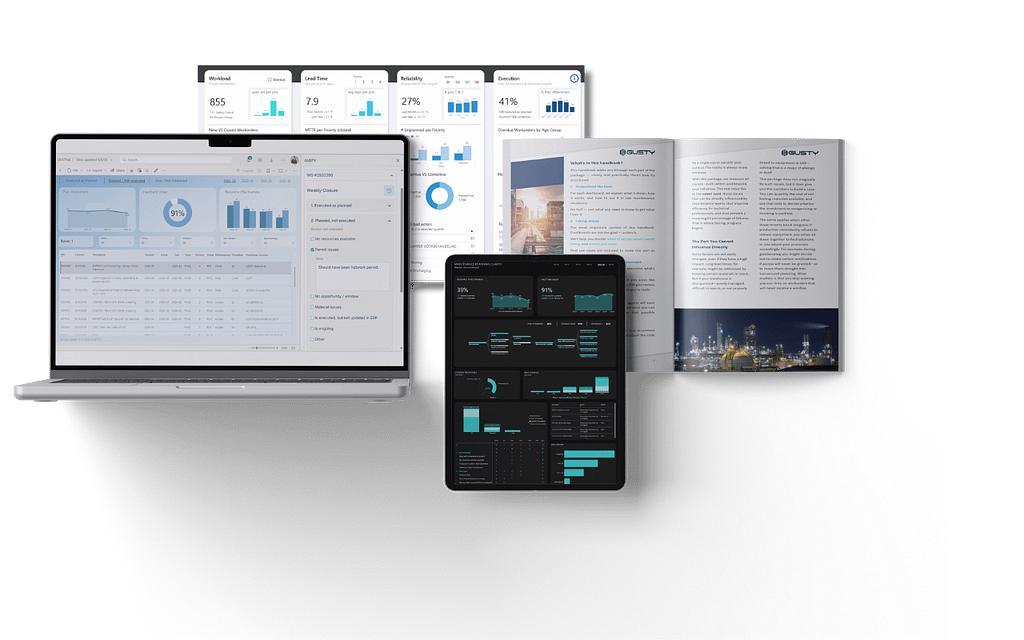
Most maintenance teams have a set of dashboards with their key KPIs. Those high-level dashboards are useful: they let you see trends, compare performance, and keep an eye on the big picture. But the mistake many organizations make is treating dashboards as the final destination — as if creating and maintaining them is the ultimate objective.
Dashboards are not the goal. They are just a tool. And like any tool, they are only valuable if you use them to act.
Contents
The Problem With Dashboard Growth
If you’ve been using dashboards for a few years, you probably recognize the pattern: one KPI leads to another, and before long you’ve built dozens of views. Every new question (“why is this KPI off?”) generates another dashboard. And what do these dashboards usually show? What already happened.
That is the limitation: dashboards explain history. They don’t solve problems.
From Looking Back to Acting Forward
The real question is not what happened? but what can I do about it?
A dashboard by itself won’t take you any further than observation. If all you do is look at KPIs, you’ll only ever see the past.
The real shift happens when you add a feedback loop. Instead of only showing outcomes, you start recording the reasons behind them. For a few weeks, you not only track what went wrong, but also why. Take plan attainment as an example.
- Some work wasn’t executed because preparation was incomplete.
- In certain areas of the plant, equipment wasn’t released on time.
- Urgent jobs kept disrupting the schedule.
These insights are valuable but once you’ve identified the root causes, you don’t need to keep staring at the same dashboard. You need to take action.
For example:
- Preparation gaps → add gatekeeping checks and planner notifications.
- Late releases → make sure jobs are removed from the schedule earlier so resources aren’t wasted.
- Urgent jobs → investigate if they are legitimate and whether the process needs to change.
After a few weeks, you’ve learned what you needed to know. At that point, the dashboard has done its job. The focus shifts to tools and processes that prevent the same issues from repeating.
Beyond Plan Attainment: Resource Effectiveness
Now imagine you improved plan attainment. Great — but what about your resource effectiveness?
If you schedule only 200 hours out of 400 available, even a 90% attainment rate doesn’t mean you’re using your capacity well. That’s where another problem shows up: measuring actual hours is tricky.
In many plants, workorders are scheduled, not specific tasks. People also tend to book hours where they “fit,” because the hours have to be recorded somewhere. This makes resource data unreliable, and if you try to solve it by asking planners for more admin, you just shift the problem.
Instead, you need dashboards and report-back tools that:
- Show planners missing information in one place.
- Allow feedback or time registration in max 2 clicks.
- Replace old manual steps instead of adding new ones.
That way, dashboards stay light, actionable, and directly useful.
Why Dashboards Become the “End”
So why do so many organizations still treat dashboards as the end product?
Because it often takes months to get one. Power BI teams work project by project, moving on once a dashboard is “delivered.” Maintenance managers and planners don’t always speak the same language as BI developers. And inside Power BI, you can’t log feedback — it’s reporting only.
The result: teams push for complete, all-in-one dashboards, hoping they’ll never need to ask again. But that approach freezes dashboards into something static. They stop being tools you work with and become monuments you look at.
Dashboards Should Stay Alive
If you want to steer with data, dashboards need to stay alive. They should be short-term tools that help you uncover causes, and living tools that support ongoing action — not static reports you admire.
That’s the shift: from dashboards as an end goal, to dashboards as a means of creating control, preventing problems, and making sure improvements actually stick.
Don’t Worry, We Got You
You don’t need to build all of this from scratch.
We offer ready-made packages with dashboards designed specifically for maintenance goals. You simply pick the set that fits your needs, and run it in your own environment. You stay the full owner — you can adjust, expand, and let the dashboards grow with you.
The same goes for the feedback loop: it can be configured to match your situation, whether you want to capture reasons for missed work, track preparation gaps, or monitor urgent jobs.