AI for Predictive Maintenance: Predicting Escalation Before Failure
AI for predictive maintenance is typically associated with condition monitoring, sensor...
Our AI continuously analyzes maintenance data and highlights what your team might otherwise miss.
AI detects the operational signals that often get missed in daily maintenance work — helping teams act before reliability is impacted.
The co-pilot highlights when the execution of planned maintenance is at risk, helping teams ensure that scheduled work actually happens as intended.
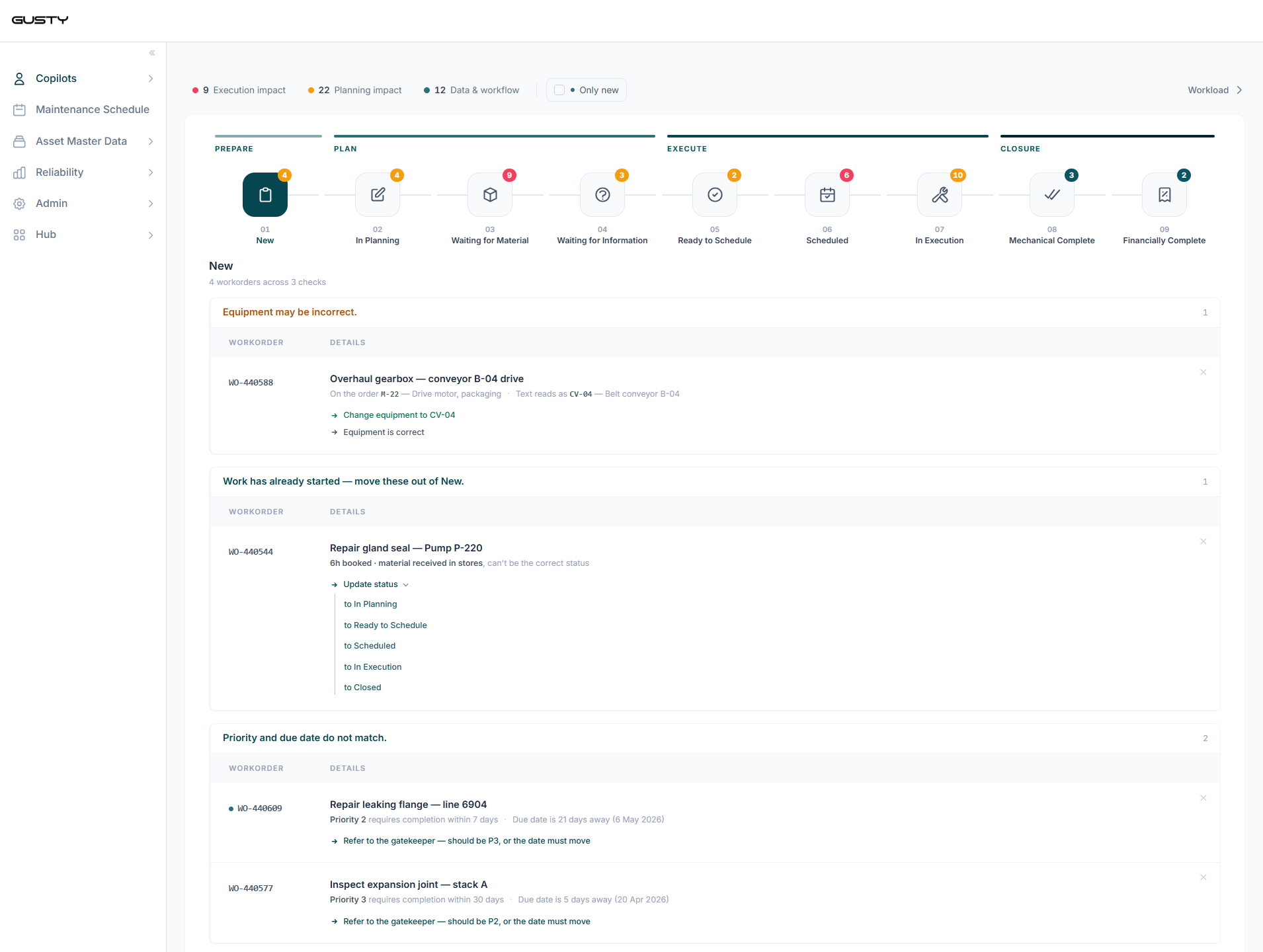
AI highlights when target dates may need reconsideration because they might get critical or escalate to higher priorty workorders.
Engineers are alerted when preventive plans may not be effective, when failures suggest a plan should exist, or when maintenance intervals may need adjustment.
The AI detects when steps in the maintenance workflow may be skipped — such as missing status updates, workorders not being closed, or purchase orders that should be completed.
The AI analyzes maintenance data from your ERP system using periodic snapshots of key tables. It detects patterns and blind spots in operations and generates signals so teams can act early. Managers receive visibility on what was detected and how issues were addressed.
Each role receives its own signals. Every alert includes the relevant information directly from SAP so teams can act immediately.


Built by maintenance professionals with hands-on experience in industrial operations around the world.
No. The AI analyzes maintenance data from your ERP system but does not change records in SAP.
It generates signals and insights so operational teams can take action within their existing workflows.
Future integrations may allow deeper interaction, but the current focus is on visibility and early detection.
No. The AI works alongside existing ERP or CMMS systems such as SAP PM.
It analyzes operational data and highlights blind spots, while teams continue working in their existing systems.
The co-pilot helps maintenance and reliability teams prevent events that impact plant reliability — often caused by things being forgotten, overlooked, or not visible in time.
Instead of chasing information throughout the day, the relevant signals come to them, making it easier to take action.
No. The AI does not analyze raw sensor or condition monitoring data.
Instead, it focuses on the operational follow-up of those insights. When engineers translate sensor findings into notifications, work orders or maintenance actions, the AI helps ensure these signals are properly followed up within planning and execution.
In other words, the AI focuses on the operational side of maintenance rather than the sensor analytics itself.
Signals are delivered through role-based dashboards designed for the maintenance and reliability team.
Operational roles such as engineers, planners and supervisors receive actionable signals they can directly follow up on. Each signal includes the relevant context from the ERP system, such as work order information, financial data and action logs.
Maintenance managers receive a higher-level view that shows how signals are being handled across the organization. They can see how many signals were generated, how many were acted upon, rejected or still open, providing visibility into how operational risks are being managed.
This allows operational teams to act quickly, while managers gain clear insight into the effectiveness of the response.
Not exactly.
Instead of predicting failures from sensor data, the AI analyzes operational maintenance data to detect blind spots in daily maintenance processes.
Implementation is lightweight and does not require a live connection to your ERP system.
The AI works with periodic snapshots of maintenance data from your ERP or CMMS, typically a few times per week. In many cases this can simply be done through exports of key tables.
Because the system analyzes existing operational data, it does not interfere with current workflows. Maintenance teams continue working in their ERP system as usual.
The AI agents are configured to prioritize quality over quantity of signals, avoiding notification overload. During the initial phase the system is carefully tuned, while the AI continues to learn and improve in the background.
The AI helps prevent issues that typically arise when signals are overlooked, actions are delayed, or processes are not followed up in time.
In practice, this helps teams to:
prevent lower priority work orders from escalating into urgent failures
improve the effectiveness of preventive maintenance plans
prevent backlog growth and overdue work
improve maintenance compliance and planning reliability
reduce work order lead times
save time currently spent reviewing data and chasing information
At the same time, the system generates additional operational insights by tracking how signals are handled. This helps organizations better understand first-time-right performance and identify maintenance process bottlenecks.
AI for predictive maintenance is typically associated with condition monitoring, sensor...
https://youtu.be/aUzzE0YvsiM

Marketing Manager
Lorem ipsum dolor sit amet, consectetur adipiscing elit, sed do eiusmod tempor incididunt ut labore et dolore magna aliqua.

Social Media Manager
Lorem ipsum dolor sit amet, consectetur adipiscing elit, sed do eiusmod tempor incididunt ut labore et dolore magna aliqua.

Social Media Specialist
Lorem ipsum dolor sit amet, consectetur adipiscing elit, sed do eiusmod tempor incididunt ut labore et dolore magna aliqua.

Project Manager
Each role receives its own signals. Every alert includes the relevant information directly from SAP so teams can act immediately.
Lorem ipsum dolor sit amet, consectetur adipiscing elit, sed do eiusmod tempor.
Lorem ipsum dolor sit amet, consectetur adipiscing elit, sed do eiusmod tempor incididunt ut labore et dolore magna aliqua.